

National Action Plans (NAPs) are policy documents that aid Governments to set out priorities, actions and coordinate better in addressing specific challenges. In 2014, the Human Rights Council called on all member states to develop NAPs to implement the United Nations Guiding Principles (UNGPs) on Business and Human Rights. In this context, NAPs are the first step in articulating concrete commitments and goals towards protecting against adverse human rights impacts involving business enterprises.[1]
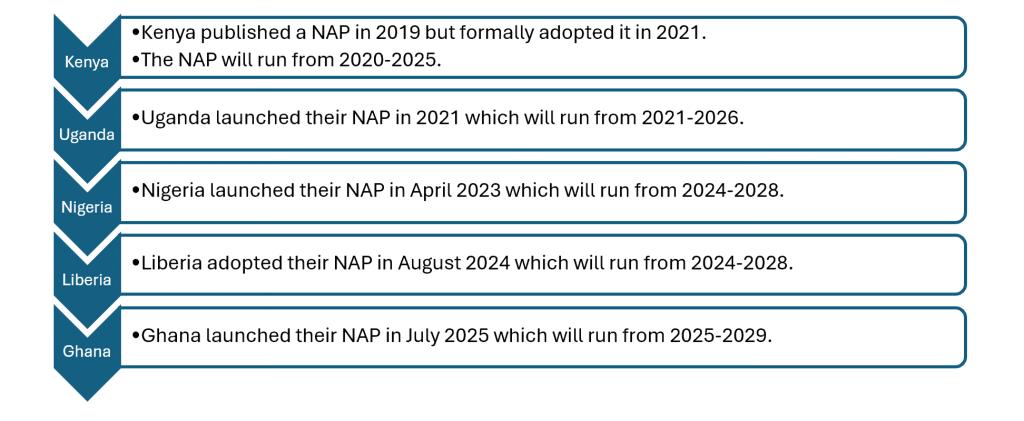
The adoption of National Action Plans (NAPs) on Business and Human Rights in the African Continent has been progressing at a snail’s pace. Only five out of fifty-four African countries have so far adopted NAPs, while several others are still in the formulation process.
The timeline below is illustrative:
The United Nations Working Group on Business and Human Rights outlined four essential criteria considered indispensable for effective NAPs, that is,
- NAPs should be founded on the United Nations Guiding Principles (UNGPs) on Business and Human Rights;
- NAPs need to be context-specific and address the country’s actual and potential adverse corporate human rights impacts;
- NAPs need to be developed in inclusive and transparent processes; and
- NAP processes need to be regularly reviewed and updated.[2]
[1] https://www.ihrb.org/resources/what-are-national-action-plans-naps
[2] https://www.ohchr.org/sites/default/files/Documents/Issues/Business/UNWG__NAPGuidance.pdf
An analysis of the five adopted NAPs reveals that this guidance has been taken into account and has helped to give structure to the NAP development process. This has therefore emerged as a best practice example for all countries developing their NAPs.
All the current NAPs begin with an overview of the formulation and development process outlining the background, problem statement, methodologies and objectives of developing the NAPs. The common goal of all five NAPs is for the State to provide businesses with a blueprint or roadmap to ensure compliance with human rights standards and principles, to mitigate the adverse impacts of their operations and to provide mechanisms for effective remedies for rights-holders affected by business operations. This is in line with the ‘Protect, Respect, Remedy’ Framework of the United Nations Guiding Principles on Business and Human Rights.
Points of divergence appear when analyzing the NAP thematic areas of focus depending on a country’s field consultation and situational analysis as highlighted below:
| Kenya | Uganda | Nigeria | Liberia | Ghana |
|
|
While it has not distinctly set out thematic areas of focus, the following can be garnered:
|
|
|
The Ghana NAP is to be lauded in so far as it is clearly a result of conducting a situational analysis across several sectors including extractives, agriculture, blue economy, tourism and creative industry, manufacturing, financial and banking sectors as well as information, communications and technology. This wide consultation revealed more cross-cutting issues than has traditionally been the case in previous NAPs as illustrated above. This is a good lesson for those still in the development phases of their NAPs as well as for countries such as Kenya whose NAPs are coming up for review. The understanding of business and human rights issues has expanded in the continent and should not merely take a traditional lens.
The policy statements and actions in the various NAPs in response to the thematic areas raised mirror the three-pillar framework of the UNGPs. Of interest is Liberia’s NAP which has taken each thematic area of focus and articulated policy actions as per the three pillars under each issue. This gives greater clarity for policy actions than sweeping statements cutting across all thematic areas. Further, the Ghana NAP in analyzing the strategies in achieving the three pillars includes timelines for implementation of these policy actions which helps to foster transparency and accountability and a clear way to measure the progress in the implementation of the NAP. The Ghana NAP also clearly indicates the implementing agency for each strategy and activity which clarifies the roles for different agencies and avoids duplication of efforts.
All five NAPs include implementation strategies. The Uganda NAP does not simply state the institutional framework but delves into the roles and responsibilities of the various players giving clear insight into coordination, monitoring and evaluation. This is a best practice example as simply articulating the framework without spelling out roles and responsibilities will foster implementation gaps in future. Interestingly, the Liberia NAP adds an analysis of the estimated budget of the various interventions against indicators, expected outputs and means of verification. This is a unique addition as the other NAPs remain silent on matters budget.
The Ghana NAP provides a detailed implementation arrangement with a clear institutional framework for implementation and reporting as well as a monitoring and evaluation framework. Additionally, a best practice example that could be adopted across future NAPs is the inclusion of a Communications Strategy in the Ghana NAP aimed at informing, educating building capacity and sensitizing state agencies, businesses, civil society organizations and rights holders to the NAP and gathering stakeholder feedback to shape implementation and subsequent review.
In conclusion, the recent launch of the Ghana NAP is a welcome step in promotion of human rights compliance and accountability by business actors operating in Africa. Other African countries should also adopt National Action Plans as a positive step towards mainstreaming business and human rights in the continent, but should consider setting out a proper framework to support policy actions, implementation, coordination and effective monitoring.